Showing posts with label nature. Show all posts

Sunday, April 27, 2014

...do it tomorrow


All I kept saying was rad. The people, totally rad. The weather, the view, totally rad. The activities, professions, museums, performances, all rad. But what an outdated word for New Mexico! It is no longer the 80s, Simon; no one’s saying rad. Except me in New Mexico, apparently. But I couldn’t help it.

The Midwest is back there...ahead is the South West

Before I left I had a feeling I would like the South West, and I did. It began the moment I crossed into the state…something in the air shifted, perhaps. We were no longer in Kansas—thank God—and Oklahoma was behind us too. We were officially in the South West. The landscape responded immediately, as if to greet us from a deep sleep. First there were the easy, deep breaths in rolling hills. Then the mesas—glorious mesas!—rose in first movements and fresh eyes. That kind of love only morning sees gently grew into mountains in  the seated position, eyes rubbed with clouds. And that sun, fully awake, smiled at me and said ‘hello’ in a ‘good morning’ kind of way.

Omega Bridge outstide Taos, NM
Our first stop was in Taos, an artsy spiritual town unsurprisingly nestled in the heavens. In every direction you can see for miles and miles and then up even higher to surrounding peaks. In one corner lies the land of the Pueblo Indians, the other has a shrine to poet D. H. Lawrence, and in between are the shops and restaurants of tourist-fed wares and well-fed tourists. Indian artifacts and artwork, cowboy garb and southwestern spices were in the windows of shop after shop. But it is becoming with a view. Maybe even quaint
Easter sunrise in Arizona
At the Taos Diner II we interacted with genuine gals more concerned with contact and communication than orthodoxy, and I enjoyed every bit of it, from the off-color jokes printed on their menus to the casual way they poured coffee, to the matter-of-factedly way they denied service when the power went out. We sat and drank coffee until it went cold or the electricity came back on and told stories of bears in the mountains. Outside the restaurant the cook toked on her cigarette and laughed with the neighboring businessman about the situation.

It is the land of mañana, apparently, so this is par for the course. I met a transplanted New Yorker who told me that first when he explained the difference between “the way it works” in the North East and South West. Cowboy poet S. Omar Barker (aka Ol’ SOB) said it this way:

Mañana is Spanish word I’d sometimes like to borrow.
It means “don’t skeen no wolfs today that you don’t shot tomorrow!
An’ eef you got some jobs to do, in case you do not wanna,
Go ‘head an’ take siesta now! Tomorrow ees mañana!

Le Canyón Grande
But I like it this waynot so fast paced and crazed, with less stress clinging to us like our wintery garments.  I like that it is markedly different in the South West. The character is distinct from other state clusters. Maybe that's why I'm on the West Coast and finally getting to this haphazard post. Santa Fe is growing on me. Or maybe that’s why everything was rad—because it wasn’t cool, like California, or wicked like the North East. It isn’t awesome or tight or right-on. It’s just, totally rad.

Friday, March 21, 2014

...swing like monkeys

I awake to warbles and cuckoos I've never heard before. There's this continuous coo, a passing crick-crick-criiiiiiick, staccatoed chirps--I start because someones creeping into my room only to realize somewhere out my window there is a bird that sounds like a slow squeaky hinge. I go outside and catch just the glimpse of a species I've never seen before, not even in pictures or television specials. I look up and see mangoes to my right, still green, and coconuts hanging higher; this place is ripe with biological diversity. The sun has been up and by seven in the morning is already bright and hot if you stand in it, or sit and read, as I did. A fairly consistent breeze greets us in the morning, though (and will rock us to sleep later at night).  

Perhaps we knew it would be a good day when we turned the car on with a chug-chug-eeeeerk and the blessed air conditioning worked. The cool air almost immediately caressed our sticky foreheads and necks. Air conditioning is a novelty during the hottest part of the year in Nicaragua, especially when your car is ancient, has an unfamiliar name, and is a chronic in-patient.  Before we left I thought about changing into a t-shirt for the sleeves so that I didn't stick out so clearly as a gringo, but kept on the cut-off to keep out the heat. I'm 25% taller than everyone here, and 95% whiter, anyway....not much chance for blending in.

But my friend's rig dig swell, and took us all the way to Granada (and back) with only one minor keys-locked-in-vehicle situation. We passed through dirt cow trails onto paved highways that yawn between rotaries, like arteries connecting the urban organs. Amidst chatter I watched as camels' backs rose lazily from the earth and were being herded as their peaks jockeyed with one another as my perspective changed. Elsewhere the green extended into near-jungle complexity, and beyond that the dust-veiled mountains were jagged like sharks' teeth.

Granada is a colorful town that sits on a big lake in Nicaragua and has all of those pesky characteristics found in touristy towns all over the world: carts selling promises of handmade wares, coffee shops  and bars, nice hotels, shops full of trinkets you can buy anywhere even though they claim their prices are lowest or quality highest, and so on. This town is strange though--at least, the central square is anyway--because you feel like you stepped awkwardly back in time. The architecture is clearly colonial, an uncomfortable reminder of the historic collision between native and European, a reminder which is augmented by all the Nicaraguan service and foreign patronage. I feel antiquated as I stroll through the park entertained by a big drum-and-puppet show and watching horse-drawn carriages cart people around. I find that it is easy to feel guilty, being a descendant of the conquistadors and colonialists and explorers who so unintentionally brought over genocidal microbes and (fairly intentionally) racial superiority and religious arrogance.

Grenada is a beautiful place, though, where buildings are separated more by vibrant color changes rather than spaces or fences or yards, and the people are kind, however persistent. We greet each other with a simple Bueno--Nicaraguans drop the "s," informally, it seems. We took a boat ride around Las Isletas and were struck not only by the incredible beauty, but also by the great divide between locals, who erected shacks on the islands they inhabited, and the others (mostly foreigners--we saw the Stars and Stripes hanging outside one), who have constructed mansions and pools and bars and docks on their paradise escapes. 

When we dock I ask my friend to take me to his favorite restaurant, expecting one of those dingy spots managed by someone's grandmother, one of those shacks you'd pass by otherwise, unaware of the magical meal provided, but no--instead he took me to TipTop, Nicaragua's KFC, where his eyes went wide with childlike excitement. It was good, but had no grandmother's recipe.

Nearby the city we went for a zip-line adventure where I just about maxed out the system's weight and size limits. Guided by friendly--quite friendly (they put my harness on for me and I thought about asking them if they'd like my number first!)--Nicaraguans, we traversed through a Robinson Crusoe kind of course. From treehouse to treehouse, and in all kinds of positions, we swung through the air, quite like monkeys. Well, quite unlike monkeys, being strapped in a harness and attached to a cable. But still, potato-potahto.

 My favorite line was the highest and longest one, where I was attached in the back and flew like Superman high above everything else, and I thought, This must be what flying feels like...And then I thought, This is probably not what flying feels like,  seeing as my harness was cutting into me and I couldn't breathe and this Nicaraguan was holding my legs like I was giving birth upside down...like I said, potato-potahto.

The good day ended well though, bruises aside. I may not be too monkey-ish myself, but I did get to play with a real, live monkey. Dexter is a white-faced monkey who was initially intimidated by his more advanced cousin, but quickly preferred my predictable touch to the childrens' erratic behavior. He clung to my arm with all five appendages, ate the bread I fed him and curiously pulled the feathers of our parrot friend who stood on my shoulder. What an incredible species! And after washing my arm quite well, I found myself in bed, being lulled by a fan which blocked out the chatter going on outside. As interesting as it is to listen to and interact with, it's near impossible to fall asleep amidst.

Sunday, July 28, 2013

...knock it off

I am on a bus returning to Kathmandu, leaving sweet Pokhara behind. We left the Kathmandu Valley a week and a half ago, begrudging the seven-hour bus ride to Pokhara hardly at all. We were saying good bye to a sandy atmosphere filled with black, grimy exhaust that left lungs dusty and skin caked. We were leaving behind the noises of grating horns and barking strays as well, those increasingly unbearable characteristics of urban centers. At night the canine choir would light up and I would wonder how we could get them to knock it off by entertaining notions of government-funded neutering initiatives. Seven hours was a pleasant price to pay, and as it wound up and down the foothills of the Himalayas, I only enjoyed it more. But now we're saying hello. Again.

But Kathmandu has her collection of beautiful things, too.

In Thamel where we stay there are shops upon shops of handmade items and knock-off goods, made-to-look-like brands and religious tokens, souvenirs and cheesy t-shirts. And in each one there are beautiful people. Their skin is darker, their smiles brighter. Many have those comfortable wrinkles that speak stories of their own. Some toothy grins are, well, toothless, and their eyes are shining, though often so dark there is no distinction between iris and pupil. Conversation is relaxed, easy; tea is sweet and milky; laughter is not hard to find.


I went to a Nepali church service where we sat in rows on the ground, cross-legged and split: women on the right, men on the left. Up front there were six people singing, a guitarist, bassist and drummer. The room was a concrete rectangle with a tin roof and hanging ceiling fans. In front of me sat a young, passionate man who raised his right hand in worship with a four-letter word tattooed on his knuckles. I smiled and longed for the story behind it.

We also visited Pashupati, the most holy site for all Hindus. This is a temple to Shiva, the destroyer, and within the Hindu-only site for worship sits a giant golden calf--I mean bull--that people pay homage to. Nepali, Indian, Chinese all whisk past us on their way in and out. Some people hope to get to this temple just once in their lifetime, a relationship like Muslims have with Mecca. Hopefully your visit isn't also your funeral, but such is the case for many. Right next to the temple is the ceremonial cremation site along the river, and you can smell it in the air. Several stone platforms support the bonfires of departing lives going on to join the five elements: the body is burned by fire, the body becomes like earth, the smoke floats into the air, the ash is placed in the water and their spirit ascends to Sky. 
However strange it was for us to see burning bodies, and stranger to smell them, it was a fascinating sight. Groups of mourners stood at every stage in the process: some were saying good-bye to their shrouded loved-one as he lay by the lapping current, some, red and puffy-eyed, were watching the fire smolder after hours of flame, and some the ashes being swept into the river. A group even carried one body in on a small bed, tears held back by duty.


But we've left that behind for Lakeside, Pokhara, Nepal. Here dark-skinned boys strip down to their underwear and dive into the warm lake water. They come out gleaming in the sun, smooth, smiling. Some have found a little drop-off and are leaping the ten feet down, splashing below. It is quite hot after all, and even we take an opportunity to leap, fully-clothed, into the lake and swim out to an island where sits a famous hotel owned by the royal 
family. Many dignitaries and celebrities have stayed here and their names are carved on wooden plaques hung outside the room they stayed in. We just sit with an old friend for tea and conversation. The beauty of the shade, the grass, the trees and mostly, the view, gives a sense of youthfulness. It is a kind of paradise here in Pokhara. 

On the outskirts of town winds a river that cuts a deep gorge. It is lower than the lake and thus fed by it, among other sources. There is a family we are good friends with and we took a couple of the young guys to this river for an afternoon of playing in the water. We found a good rock from which to jump and I swam down to see how deep it was there, but quickly resurfaced before I could feel anything; it was too creepy. We leaped into the water, launched them from shoulders and raced back and forth. These boys are brothers, but not by blood; one was found and taken in by the other's mother years and years ago. A hawk circles about the nearby shallow rapids and we enjoy the natural beauty of this country and her people.

Lakeside draws in many tourists and so the main street is lined with trekking shops and restaurants, bookshops and short Tibetan women who make crafts in their refugee camp and bring them to sell. Their shop is their backpack. We have good friends here, our favorite spots for tea or Dal Bhat and a gregarious mentality. Quickly we begin relationships at the Asian Tea House or Shiva's, as we call it. We think there is some kind of divine gravity in this epitomal hole-in-the-wall, for we connect with Aussies, Malaysians, Nepali, Canadian, Chinese and a Czech/Dutch guy. One we met on the trekking road, the others we see day after day, and even one we just met again at a bus stop. Nepal is full of small-world connections, and many emanate from the milk tea conversing at Shiva's. 


Raaz, the young man who sold me gear
Because I left Kathmandu and my luggage never left America, I had to purchase a couple of items. In anticipation of the rain, I needed something as waterproof as possible. So I did a bit of shopping. Nepal is a land of inflated prices. With so many tourists passing though her villages and cities, the locals have learned to price everything high. Bartering is expected and they will still come out with something of a profit. 
Though I am not a great barterer, I managed to knock off about half of the price that a Tibetan woman asked for; I know she still made off well. This is the case in the capitol as well, where every shop sells the same things and I can get a couple hundred rupees removed fairly easily. Our shop-owning friends give us the inside scoop: it isn't really yak, it isn't really handmade, it isn't really made in Nepal. But they point us to the things that are. 


Yes, the capitol towards which I head once again. There was no good-bye to Pokhara, though; we will return. My heart is there right now and I'll go get it next week. For now I'll partake in the joy of a dog--well, a joy of a dog. No, I will not be urine-marking my space or greeting with a sniff. I'll be sticking my head out of the window. Here, in these tiny taxis, I do this in order to fit in the vehicle, especially when we max out her capacity. And I find that it is delightful to watch everything pass as the wind cools off my sweating brow. Of course I have to lean carefully in order to keep all my parts from departing or getting my head knocked off. 

Monday, July 22, 2013

...piqué interest

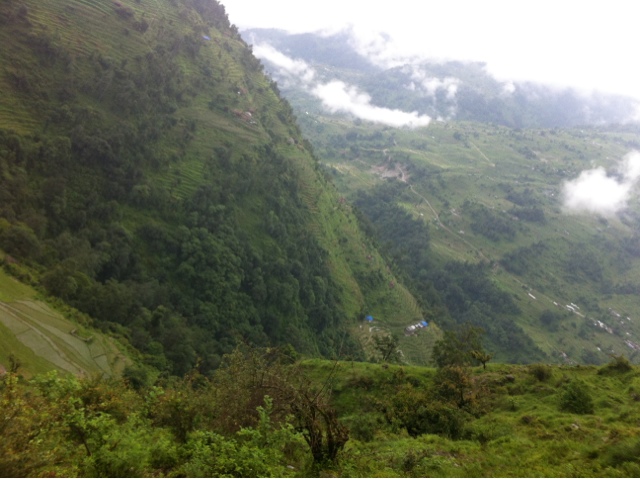
The foothills are something even pictures cannot grasp, and my words certainly hold little power to contain them. Shrouded in mist they play hide and seek, with great, strong bodies that house intricate arteries of rivers and ribboning, dancing falls. They are a deep, untouched green, and they metamorphose into heavenly beasts; covered in eyes they always look at me. As I humbly place each one of my strides on their bones, I find gratitude in the muscle of Earth below me, and below the mountain, and below that. And how they launch me into the Heavens.

There is power here; the river rages and surges with it, the mountain quietly keeps it, the air pulls, passes and pours it. I am so small, and as I cross a wooden bridge or come face to face with a leaping cliff, I am reminded of it with clarity. 

And step-by-step we climb, passing the humble homes of mountain dwellers who hike briskly in flip-flops and rubber boots. Cows and water buffalo moo in the uncomfortable rain, chickens peck pathetically, pausing to shake the water from their feathers and ruffle and re-ruffle themselves. A dog joins us, walking ahead and waiting, watching, perhaps protecting and caring for these bipedal strangers. Four children send warning shrieks from under their umbrellas to ward off the monkeys from their family's maturing corn. Three older, wrinkled, calloused, tanned men and women crush rocks with a small hammer. A bare-breasted woman with suckling child sit on their porch we so invasively pass, and many men and women of all ages carry baskets of greens on their backs, supported by a cloth strap that rests on their crown like a bandanna. To each of these we greet with our hands held together in prayer, Namaste, and they return it. From under their plastic coverings some of the friendlier ones say 'Pani! Pani!' with a smile on their face. Pani means water and they chuckle at our sopping state. I agree with them through tone. Yes, Pani. Tons of it. 

It is monsoon season in Nepal; I have never been so soaked for so long. Some of the best gear is defeated by this onslaught. Wet to the core, we continue to climb to keep warm, and we make good time for it. The real enemy are those slimy suckers that come with the rain. Perched on leaves, trees, rocks leeches attach themselves to passing flesh. When we finally take off our shoes we have endlessly leaking wounds to attend to. A cheesecloth-covered ball of salt is our weapon in removing them as we climb, but some make it through all our defenses. When I finally remove one and kill it, I watch it bleed my own blood. How audacious. 

But we finally make it to Hotel Milan high up in Ghandruk. If the clouds clear we will see the glorious snows of the Annapurna Himalayan Mountain Range. Those are the real beauties. In another season we could climb to the top, but monsoon season makes for snow-storms that are not to be reckoned with too audaciously--we wouldn't want the mountains to make us bleed our own blood, so we tread humbly. For now, we hope just for a peek. 

As we dry and tend to wounds and eat a large lunch the mist and clouds pass and dissipate and we become more and more excited, anticipating what lies behind them. Across the valley a lonely structure manifests and I wonder what it could be, with nothing around it, the closest village half a cliff away, who lives there? What do they eat? How do they even get there? The mysteries of the Himalayas continue on...


And then, in the light of morning, when the clouds haven't yet had time to cover the hills, we finally see behind the veil, and oh!--what a change! Suddenly I'm even smaller. Those mountaintops I was so moved by, whose height I was so impressed with, and breadth in awe of--they become, well, hills. Monstrous, gorgeous, green and white--pure white--peaks have been towering above us all this whole time. So quickly my perspective changes. In just a small space between the creeping clouds I see the rising thrust of Fishtail and my hike, my view, my very self, have all shrunk. In the presence of giants we see ourselves as we ought.

But the sight is short lived. From over the hilltops comes the covering. It hugs the mountainside like a woolen blanket. Like a fleece is sits and contours to the shape of the rolling, jutting earth. Within minutes we can't even see the tops of the hills, our horizon is blurred out, and we are back to a world only meters wide and long. But I'm no bigger; I know now, and I cannot forget what greatness lies all around me: the peaks of the Annapurna.

Tuesday, July 16, 2013

...struggle on

I am still without clothes or toiletries or sandals or that sweet peanut butter I packed because my luggage remains lost in that nexus of traveling. I had to buy some basic things and blushed as my life was on display in the market. Picking out underwear is such an ignoble necessity. Turns out they don't fit so well; the clothes here are made for a smaller sort of person. 

A Tibetan woman who owns a bag shop chuckled as I tried to cram a "Large" hat onto my head. She told me, "they are made for Asian." 

It isn't surprising that there are many Tibetan people living here in Kathmandu and elsewhere in Nepal. They share a border, albeit a trecherous one, and many have fled their homeland because of the Chinese invasion. These whom I interact with are mostly the children and grandchildren of those that made the first flight. 
They are a beautiful people with strong features, wide, high cheekbones and dark eyes. They are kind and hospitable and cook the best food in town. The Tibet Cafe is a favorite of ours, and there we often meet for breakfast or dinner. We eat buffalo chowmein or thukpa (soup and noodles) or eggs and potatoes with cilantro and phale bread. I tried the Tibetan tea once, but couldn't down it. It is a buttery, salty tea and without something like lobster, I just couldn't stomach it. But I had to try it once. 

We frequent the shops around this touristy area to sit and chat and share laughter. We are good friends with several shopowners and families. One sweet family has three children we get to play with and watch grow. The youngest is a girl, and she runs up to my friend Bonnie and gives her a great big hug. She is always smiling or laughing. The middle child is a boy who loves to draw, and has quite the knack for it. He proudly shows us his latest work. And the oldest, also a boy, is bright and kind and aspires to be a doctor some day, perhaps. All three of them walked with us to the illustrious Monkey Temple, or Swayambhu, which included being rained on and climbing 365 steps to the top. 

The temple gets its name from all the monkeys living right around it--those cute, all-too-human creatures with an ominous potential power. I knew if I took out my iPhone to snap a picture, it could become a monkey toy, and it almost did. I escaped with the scratches left over from this monkey who grabbed my arm. Yes, grabbed my arm. A monkey. Grabbed. My arm. 

Swayambhu is a place Buddhists come to worship. This holy site is said to be the resting spot of a giant lotus flower when the Kathmandu valley was drained by a magical sword lifetimes ago. Apparenly this bowl was once a great lake, not a expansive city. And so we climb the stairs, we struggle, one step for each day of the year, to reach the top. This is like their lives, which are lead, day by day, through struggle towards nirvana, or salvation. 

At the top we meet people circling the temple, spinning the prayer wheels as a form of resitation. We also meet hordes of salespersons spinning their stories trying to get our attention to their various wares. I was caught up into a lecture on the creation of these beautiful Tibetan paintings and learned much about the path to real life from their perspective. The young man gave me an impressive presentation about purifying your mind, then speech, then soul towards nirvana through meditation. I asked him where he was on that journey and he chuckled and sat down. 

"That is a good question," he admitted and looked for an answer to a question he never received before. "Somewhere here," he decided as he pointed at the ring around the gates to our mind, which is the beginning. I laughed and said I was probably there as well. But, as nice of a connection as we had, I was politely excused when I offered no interest in purchasing one of his paintings.
View of the Kathmandu valley
So we faced the descent, a year of struggle going up, but just a bit of bouncing to get down. Turns out my legs hurt more leaving salvation than attempting it. And my struggle was waiting for me below as I sweat through my shirt once again, yet had little to change in to. Such is the Nepali life.


Friday, July 12, 2013

...tuck in


I have just finished a delightful, fresh breakfast in a beautiful outdoor courtyard. There is a slim tree sprouting in the center and providing a light canopy above us. For somewhere between 7 and 8 in the morning, it is awful humid. Walls are made of brick or painted concrete or displaying a huge carved fresco of sorts depicting mountains, jungle, four "super natural" creatures and the "symbol of brotherhood" (a bird on a bunny on a monkey on an elephant).

There is the sound of rushing water splashing around the corner and the guttural cooing of pigeons are all interrupted by distant honks and the occasional clatter of breakfasts being made above us. Kathmandu is a crowded city where people live all over each other and small alleyways lead us to staircases that ascend into heights of living spaces and shared bathrooms. 

I am in Thamel, the part of Kathmandu that tourists frequent. The narrow streets are lined with trekking information, gear shops sporting familiar brands, bookstores, and shops selling all kinds of Nepali-made wares, from clothes to Gurkha knives, handmade bags, masks, beads and all kinds of other trinkets. Rickshaws wheel past with riders sitting in the back and the driver pedaling up front. Most people seem to drive a motorcycle or moped and those zoom past. There is much honking here from all forms of transportation and when you hear it, you inch towards the curb and feel the air whoosh as a car or bike speeds through. 


I am sitting in a pair of new pants myself, which are a bit like Aladdin's, except black. I bought them because my luggage didn't arrive with me in the country. Somehow I was expecting this and was little phased by it; I just hope they show up soon. When they do I'll take a taxi to the airport to grab them--a taxi ride that is bumpy, close, and erratic. It is a funny stereotype about this part of the world, but it is upheld: on the way over we actually hit someone on a bike and kept going without so much as a glance in the rear-view. There are no lights, only blue uniformed crossing guards standing on their shaded platform in the middle of the chaos. They seem content with the way things move. I realized I'd better tuck my elbow in or lose it, which was tougher than one might expect due to the size of the van, which was somewhere between VW and matchbox.


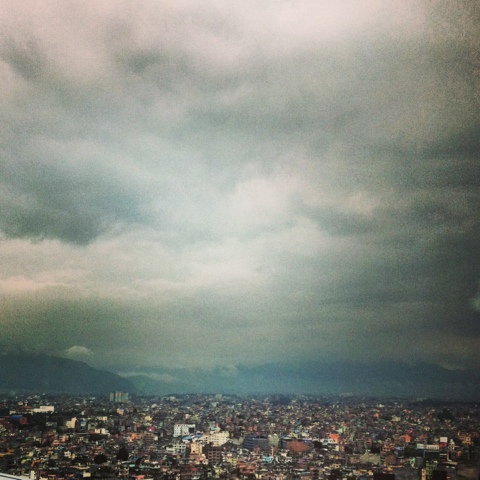
But all of it is deeply beautiful. The people are kind and friendly and hospitable in their poverty. The buildings, tangled and colorful, seem to resemble a Lego city and remind me how unique it is in Palestine to have architecture uniform in facade. And unlike the rolling hills and flat places in the Middle East, here the city spreads out like a soup in a bowl of mountains. Tall, tenacious mountains.

It is the rainy season now so the peaks are shrouded in those artistic clouds. I've seen this before--Ah, yes! In all those glorious paintings of Chinese or Tibetan landscapes. Their shapes are mysterious, coy. We know they are there, we see hints of grandeur, we sense their wisdom. At night, however, I escaped to the roof for a moment, though my body craved long-awaited sleep, and got to look over rooftops and through alleys and even into living rooms with blinking television sets and cups of tea. And above it all was the silhouetted grandeur of one potent mountain. I must have been facing the west for the light of day stubbornly draped herself on his shoulders allowing me the shape of his figure. I marveled at his size and then at the mountains of clouds that climbed up above him.

Kathmandu! I thought. I'm in Kathmandu! Yet, despite my wide-eyed wonder, the heaviness of sleep was more powerful and I climbed down and tucked myself into bed. Well, it was more of a fall-onto-and-immediately-into-sleep kind of tuck, but, either way, Kathmandu will be there in the morning. And indeed she is, awake, fresh and beautiful.

Monday, November 12, 2012

...google Wadi Rum

I remember it as a dream, even though it was only this past week…Wadi Rum. I could have been on the moon, in a painting, but not in reality.

Where are we?
Three days ago I left for my first trip to the Hashemite Kingdom of Jordan. Yes it’s a kingdom and there is a king and his picture is everywhere and people generally like him. I have been wanting to go, but necessity breeds action and my tourist visa was running out. So I went into Jerusalem and after scheduling an appointment for a work visa interview, I caught a bus far up north by means of the Jordan River Valley to a place called Beit She’an. There I grabbed a taxi to the border and after a series of questions, security checks, taxes and fees, I entered Jordan. At one point in the process my traveling partner and I had received our exit stamps, which means we had left Israel, but were waiting for a bus to take us over the river to get entry stamps into Jordan. We wondered where we really were and who would put us in jail if we committed a crime…

But wonder is all we did, and soon found ourselves under royal, setting sky. 
The setting sun from Jordan looking west

Something was different about this place. It was more open and expansive as if the land itself spoke of her freedom. This is a nation without Occupation. It is a land full of people just like the Palestinians but without checkpoints and tension. This is a place to come and go as you please without walls and gunman and x-ray machines to delay you. I could feel it in the air; it was refreshing.

My homebase was at a friend-of-a-friend's apartment. His name is Samer and he lives near the University of Jordan in Amman, a capitol city where there are millions of people and many foreigners. At one point during my trip I spoke in English and Arabic to a young Kazakh. That’s a first.


I spent the first morning grabbing a cab to Jabal al-Qala’a, or the Citadel. Atop this mountain (jabal in Arabic), there stand ancient ruins of many civilizations built atop one another, as is common in this part of the world (‘it was a temple, then a church, then a temple, then a mosque, then a church, then a mosque, now a crumbling tourist attraction’... it's a familiar mantra). 


From here we could walk around and get an exceptional 360° view of modern-day Amman, while prancing around this old fort-city. There were gorgeous ruins of a temple to Hercules, a palace, a mosque, a church, a bathhouse, a guard tower, old whispers of walls and rooms upon rooms upon underground cisterns. And when I looked up and out I saw towers and theatres and mosques and churches and hotels and houses upon houses upon the seven mountains of modern Amman. And I saw the world’s highest flag.
Amman, with a huge Roman theatre sometimes still in use.

But the focus of this trip wasn’t the citadel, or even Amman: it was Wadi Rum. I was traveling with Sofie, my Danish friend who is living in Palestine while she completes a paper for her Master’s program, and we were both eager to get out of the city. Palestine is crowded, sometimes claustrophobic. It is noisy and a bit cagey. Amman is some of those things too, and we both wanted space and quiet. So we rented a car, Sofie, Samer and I, and drove into the night, due south until we reached our destination.

The Desert Wolf at camp. He rocked my hat
so well, I gave it to him.
We were greeted by Ahmed, our Bedouin guide, the Desert Wolf, as he called himself. He was a pirate of a man who took us out into the middle of the desert, turning off his headlights at one point to look at the dark mountains for direction. I thought he was pretty cool, and I thought myself so for being there with him.

And then we stopped at our campsite.

I had a spiritual moment when I stepped out of the car. Looking up and around, letting my eyes get used to the dark, I saw massive shapes jet into the sky like the great teeth of a huge jaw. They surrounded me and would have swallowed me if not for the endlessness of the eternal night above me. Suddenly I was small and insignificant enough to gaze on the Milkiest Way I have ever seen. Honestly, I am having trouble choosing words to describe what I saw because it goes beyond what breath and tongue and lips can forge. This place awakened the vocabulary of angeltongue, of which I know not. But sometimes our bodies are smarter, or perhaps more enlightened, than our worldly-wise minds, and it knew what to do. So instead of saying anything, I ran, jumped, cartwheeled, spun, stretched and fell into a heavendance where my tongue could form no intelligence, my toes swam in the cooling desert and my entirety longed to make one grand jump from where I was to any of the infinity of stars that formed my canopy.

But my lungs exhausted long before my spirit, and I sat by the cooking fire to learn more of Ahmed and prevent my very cells from splitting from one another in ecstasy. We chatted, laughed, wrapped ourselves up and occasionally I looked up at my brobdingnagian ceiling.

Sofie and I didn’t sleep save for an hour or so. Instead, we strolled and explored, confined only by our moat of mountains, speaking of life, or silent in awe. The half-moon glossed everything, and we were quite able to find our way. We felt like we were on the moon, really, but when we looked up, we knew we couldn’t be: high and bright the arching moon chased the stars in an Olympian game of tag, and we found ourselves bewildered to look at something that couldn’t be real, could it? This place is a land one comes to in his dreams and has tea with God, finding clarity in something wholly heavenly and wholly earthly at the same time. It was incarnate, and I understood suddenly the reaction within me, of twins—no, more than twins…halves, perhaps—uniting in divinity unfettered by humanity.

Sofie in the sun.
But we knew it wasn’t over…morning was coming, and we were eager to see the sunrise and to see what our shelter looked like in greater light. A small nap sufficed to pass the time between the stars twinkling out and the sun peeking in. Tired and clunky, we rounded the corner of the nearest mountains in order to see the sun come. I have always found the sunrise to be one of the most beautiful things we can see with our eyes, but here, what he illuminated was so much more glorious. The golden light cast shadows as icebergs of stone rose out of a sandy sea around us. Ann-Sofie sat in awe; I ran into the horizon that never got any closer. Movement seemed the only proper response I could muster for such as Wadi Rum.


And then it was light and we welcomed the warmth of the sun, ate a modest breakfast and packed up camp. Ahmed drove us back to our car which we had abandoned near the road while we listened to some traditional Bedouin music and watched the gathering of the camels. We happened to be near a massive camel racetrack and today was a big day for racing. Some were being fed or watered, others walking around, awkwardly, like something out of a Dr. Suess tale. They are perhaps the only animals that ambulate by moving the feet of the same side at the same time. And then with their cleft lip, underbite and misshapen humps, they really are the goofiest of animals. And they got attitude, too. They spit and look at you with long lashes, bending their necks away from your approaching hand as if to say, “Nu-uh, not today brutha.” So sassy, they are. 
Driving in Jordan

But we had traveling to do so we couldn’t stay. The car hit the road again, this time with me at the helm. Driving is a pleasure I thoroughly miss, so guiding our rental up and down the hills and through the dessert, dodging Maersk trucks and other semi-trucks was quite the gift.

Later that night I found myself back in Palestine, having crossed the King Hussein or Allenby Bridge and passed through three sets of customs (Jordanian, Israeli and Palestinian), being driven from Arriha (Jericho) back to Khalil. I passed into that place between wakefulness and sleep and visited Wadi Rum all over. When I got out of the van and walked to my apartment I wondered if I had really been there, or if it was a dream all along...
Jordanian Desert


The World's Highest Flag


Can you find Sofie?