Showing posts with label hiking. Show all posts

Friday, August 30, 2013

...pay for tea


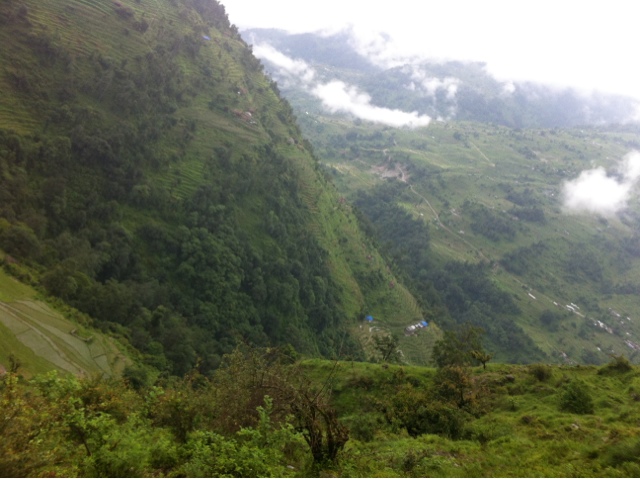
View from Landruk
On the first day of our trek we stopped in a little mountainside village called Landruk. We sat down after many long hours of trekking and it felt good, ordered some hot lemon tea and began stripping off anything wet or muddy. We indulged in that wonderfully simple pleasure of taking off your shoes after being in them all day. And then we took off our socks in euphoria. What a sweet truth in life it is that putting on clean socks feels so gratifying, and taking them off does too. There were quite a few young Nepali girls who waited on us, with coconut skin and vanilla bean hair. They flitted around, working, half-playing, watching the strangers that come into their home day after day. They find my inability in Nepali to be a grand comedy and as we get ready to leave the next day in the pouring rain, they chuckle behind veiling hands when I learn how to say "I'm crazy."


But we have an evening in front of us, nestled in the slowly disappearing mountains. A young Dutchman approached us looking for company and we couldn't help but like him and we invited him to join us for the tea that was brewing. We sat and shared stories of home and of culture and of trekking. Nathan's agnostic, we're Christian, and so our conversation even touched on religion and life, as it does often in the non-Western world. We're loud Americans; he's actually Czech, but was raised in the Netherlands. He told us that in the Netherlands people are "cheap" and never pay for one another. Even if you are invited over to eat, be prepared to pay something to help cover the cost. We balked at this, said good-night and he went to his own lodging. He didn't pay for tea. How Dutch.

In the morning we looked for our Dutczech friend, but sadly had to go before he woke up. The torrential downpour was a bit hard to navigate through, anyway. It was here, looking down the face of the mountain, when I said “I’m crazy.” But eventually we got moving. However, we came to discover that what follows is typical. Almost a week later two of us were on our way to dinner in Pokhara and spotted a hairy-faced, v-neck and flat-cap wearing oaf. We laughed and embraced and invited Nathan to eat with us. He accepted, but only for a drink, he said. 
photo cred: Bonnie Cohee
At Shiva's Tea House we shared even more stories and traded pictures of mountains, but as we waited for our food Nathan dove back into questions of religion and faith and life and morality. Nathan is one of the best question-askers I've ever met, and his blunt honesty is why. He ordered a beer and drank it and when we couldn't finish all the momos, he gladly accepted our leftovers. We parted ways again, smiling and satisfied. We bought the food, he bought the beer.

A week later, after we'd arrived back in Kathmandu, we decided it was time to go get some good lattes. Himalayan Java is the Starbucks of Nepal and so we rolled up, bleary-eyed and annoyed by the urban cacophony for some real espresso. We ascended the stairs, turned to sit and were staring directly at a smiling Dutchman. A chorus of love and reunion erupted between hugs and laughter and short stories. We coined the term/hashtag "smc" for "small world connection" and immediately set to posting pictures to Instagram (simonwskold). We all ordered something caffeinated and spent our time sipping in the pleasure of this serial relationship. 
photo cred: Bonnie Cohee
We expressed our growing fondness for each other, exchanged information and gave open invitations to our homes and cities and when Nathan departed in a flurry of smiles and hugs and ‘Namaste’s’, we set about our own business. We even mentioned to one another how much we were blessed and impacted by Nathan’s friendship.

And after an hour or so, we went to leave and asked for the bill. The man behind the counter, however, looked funny and said "that man before paid for you all." Our jaws dropped. We couldn't help but comment (loudly, of course) on how sweet Nathan really is, how much we really do love him and how un-Dutch he'd become.
photo cred: Bonnie Cohee


Sunday, July 28, 2013

...knock it off

I am on a bus returning to Kathmandu, leaving sweet Pokhara behind. We left the Kathmandu Valley a week and a half ago, begrudging the seven-hour bus ride to Pokhara hardly at all. We were saying good bye to a sandy atmosphere filled with black, grimy exhaust that left lungs dusty and skin caked. We were leaving behind the noises of grating horns and barking strays as well, those increasingly unbearable characteristics of urban centers. At night the canine choir would light up and I would wonder how we could get them to knock it off by entertaining notions of government-funded neutering initiatives. Seven hours was a pleasant price to pay, and as it wound up and down the foothills of the Himalayas, I only enjoyed it more. But now we're saying hello. Again.

But Kathmandu has her collection of beautiful things, too.

In Thamel where we stay there are shops upon shops of handmade items and knock-off goods, made-to-look-like brands and religious tokens, souvenirs and cheesy t-shirts. And in each one there are beautiful people. Their skin is darker, their smiles brighter. Many have those comfortable wrinkles that speak stories of their own. Some toothy grins are, well, toothless, and their eyes are shining, though often so dark there is no distinction between iris and pupil. Conversation is relaxed, easy; tea is sweet and milky; laughter is not hard to find.


I went to a Nepali church service where we sat in rows on the ground, cross-legged and split: women on the right, men on the left. Up front there were six people singing, a guitarist, bassist and drummer. The room was a concrete rectangle with a tin roof and hanging ceiling fans. In front of me sat a young, passionate man who raised his right hand in worship with a four-letter word tattooed on his knuckles. I smiled and longed for the story behind it.

We also visited Pashupati, the most holy site for all Hindus. This is a temple to Shiva, the destroyer, and within the Hindu-only site for worship sits a giant golden calf--I mean bull--that people pay homage to. Nepali, Indian, Chinese all whisk past us on their way in and out. Some people hope to get to this temple just once in their lifetime, a relationship like Muslims have with Mecca. Hopefully your visit isn't also your funeral, but such is the case for many. Right next to the temple is the ceremonial cremation site along the river, and you can smell it in the air. Several stone platforms support the bonfires of departing lives going on to join the five elements: the body is burned by fire, the body becomes like earth, the smoke floats into the air, the ash is placed in the water and their spirit ascends to Sky. 
However strange it was for us to see burning bodies, and stranger to smell them, it was a fascinating sight. Groups of mourners stood at every stage in the process: some were saying good-bye to their shrouded loved-one as he lay by the lapping current, some, red and puffy-eyed, were watching the fire smolder after hours of flame, and some the ashes being swept into the river. A group even carried one body in on a small bed, tears held back by duty.


But we've left that behind for Lakeside, Pokhara, Nepal. Here dark-skinned boys strip down to their underwear and dive into the warm lake water. They come out gleaming in the sun, smooth, smiling. Some have found a little drop-off and are leaping the ten feet down, splashing below. It is quite hot after all, and even we take an opportunity to leap, fully-clothed, into the lake and swim out to an island where sits a famous hotel owned by the royal 
family. Many dignitaries and celebrities have stayed here and their names are carved on wooden plaques hung outside the room they stayed in. We just sit with an old friend for tea and conversation. The beauty of the shade, the grass, the trees and mostly, the view, gives a sense of youthfulness. It is a kind of paradise here in Pokhara. 

On the outskirts of town winds a river that cuts a deep gorge. It is lower than the lake and thus fed by it, among other sources. There is a family we are good friends with and we took a couple of the young guys to this river for an afternoon of playing in the water. We found a good rock from which to jump and I swam down to see how deep it was there, but quickly resurfaced before I could feel anything; it was too creepy. We leaped into the water, launched them from shoulders and raced back and forth. These boys are brothers, but not by blood; one was found and taken in by the other's mother years and years ago. A hawk circles about the nearby shallow rapids and we enjoy the natural beauty of this country and her people.

Lakeside draws in many tourists and so the main street is lined with trekking shops and restaurants, bookshops and short Tibetan women who make crafts in their refugee camp and bring them to sell. Their shop is their backpack. We have good friends here, our favorite spots for tea or Dal Bhat and a gregarious mentality. Quickly we begin relationships at the Asian Tea House or Shiva's, as we call it. We think there is some kind of divine gravity in this epitomal hole-in-the-wall, for we connect with Aussies, Malaysians, Nepali, Canadian, Chinese and a Czech/Dutch guy. One we met on the trekking road, the others we see day after day, and even one we just met again at a bus stop. Nepal is full of small-world connections, and many emanate from the milk tea conversing at Shiva's. 


Raaz, the young man who sold me gear
Because I left Kathmandu and my luggage never left America, I had to purchase a couple of items. In anticipation of the rain, I needed something as waterproof as possible. So I did a bit of shopping. Nepal is a land of inflated prices. With so many tourists passing though her villages and cities, the locals have learned to price everything high. Bartering is expected and they will still come out with something of a profit. 
Though I am not a great barterer, I managed to knock off about half of the price that a Tibetan woman asked for; I know she still made off well. This is the case in the capitol as well, where every shop sells the same things and I can get a couple hundred rupees removed fairly easily. Our shop-owning friends give us the inside scoop: it isn't really yak, it isn't really handmade, it isn't really made in Nepal. But they point us to the things that are. 


Yes, the capitol towards which I head once again. There was no good-bye to Pokhara, though; we will return. My heart is there right now and I'll go get it next week. For now I'll partake in the joy of a dog--well, a joy of a dog. No, I will not be urine-marking my space or greeting with a sniff. I'll be sticking my head out of the window. Here, in these tiny taxis, I do this in order to fit in the vehicle, especially when we max out her capacity. And I find that it is delightful to watch everything pass as the wind cools off my sweating brow. Of course I have to lean carefully in order to keep all my parts from departing or getting my head knocked off. 

Monday, July 22, 2013

...piqué interest

The foothills are something even pictures cannot grasp, and my words certainly hold little power to contain them. Shrouded in mist they play hide and seek, with great, strong bodies that house intricate arteries of rivers and ribboning, dancing falls. They are a deep, untouched green, and they metamorphose into heavenly beasts; covered in eyes they always look at me. As I humbly place each one of my strides on their bones, I find gratitude in the muscle of Earth below me, and below the mountain, and below that. And how they launch me into the Heavens.

There is power here; the river rages and surges with it, the mountain quietly keeps it, the air pulls, passes and pours it. I am so small, and as I cross a wooden bridge or come face to face with a leaping cliff, I am reminded of it with clarity. 

And step-by-step we climb, passing the humble homes of mountain dwellers who hike briskly in flip-flops and rubber boots. Cows and water buffalo moo in the uncomfortable rain, chickens peck pathetically, pausing to shake the water from their feathers and ruffle and re-ruffle themselves. A dog joins us, walking ahead and waiting, watching, perhaps protecting and caring for these bipedal strangers. Four children send warning shrieks from under their umbrellas to ward off the monkeys from their family's maturing corn. Three older, wrinkled, calloused, tanned men and women crush rocks with a small hammer. A bare-breasted woman with suckling child sit on their porch we so invasively pass, and many men and women of all ages carry baskets of greens on their backs, supported by a cloth strap that rests on their crown like a bandanna. To each of these we greet with our hands held together in prayer, Namaste, and they return it. From under their plastic coverings some of the friendlier ones say 'Pani! Pani!' with a smile on their face. Pani means water and they chuckle at our sopping state. I agree with them through tone. Yes, Pani. Tons of it. 

It is monsoon season in Nepal; I have never been so soaked for so long. Some of the best gear is defeated by this onslaught. Wet to the core, we continue to climb to keep warm, and we make good time for it. The real enemy are those slimy suckers that come with the rain. Perched on leaves, trees, rocks leeches attach themselves to passing flesh. When we finally take off our shoes we have endlessly leaking wounds to attend to. A cheesecloth-covered ball of salt is our weapon in removing them as we climb, but some make it through all our defenses. When I finally remove one and kill it, I watch it bleed my own blood. How audacious. 

But we finally make it to Hotel Milan high up in Ghandruk. If the clouds clear we will see the glorious snows of the Annapurna Himalayan Mountain Range. Those are the real beauties. In another season we could climb to the top, but monsoon season makes for snow-storms that are not to be reckoned with too audaciously--we wouldn't want the mountains to make us bleed our own blood, so we tread humbly. For now, we hope just for a peek. 

As we dry and tend to wounds and eat a large lunch the mist and clouds pass and dissipate and we become more and more excited, anticipating what lies behind them. Across the valley a lonely structure manifests and I wonder what it could be, with nothing around it, the closest village half a cliff away, who lives there? What do they eat? How do they even get there? The mysteries of the Himalayas continue on...


And then, in the light of morning, when the clouds haven't yet had time to cover the hills, we finally see behind the veil, and oh!--what a change! Suddenly I'm even smaller. Those mountaintops I was so moved by, whose height I was so impressed with, and breadth in awe of--they become, well, hills. Monstrous, gorgeous, green and white--pure white--peaks have been towering above us all this whole time. So quickly my perspective changes. In just a small space between the creeping clouds I see the rising thrust of Fishtail and my hike, my view, my very self, have all shrunk. In the presence of giants we see ourselves as we ought.

But the sight is short lived. From over the hilltops comes the covering. It hugs the mountainside like a woolen blanket. Like a fleece is sits and contours to the shape of the rolling, jutting earth. Within minutes we can't even see the tops of the hills, our horizon is blurred out, and we are back to a world only meters wide and long. But I'm no bigger; I know now, and I cannot forget what greatness lies all around me: the peaks of the Annapurna.