Showing posts with label language. Show all posts

Friday, March 21, 2014

...swing like monkeys

I awake to warbles and cuckoos I've never heard before. There's this continuous coo, a passing crick-crick-criiiiiiick, staccatoed chirps--I start because someones creeping into my room only to realize somewhere out my window there is a bird that sounds like a slow squeaky hinge. I go outside and catch just the glimpse of a species I've never seen before, not even in pictures or television specials. I look up and see mangoes to my right, still green, and coconuts hanging higher; this place is ripe with biological diversity. The sun has been up and by seven in the morning is already bright and hot if you stand in it, or sit and read, as I did. A fairly consistent breeze greets us in the morning, though (and will rock us to sleep later at night).  

Perhaps we knew it would be a good day when we turned the car on with a chug-chug-eeeeerk and the blessed air conditioning worked. The cool air almost immediately caressed our sticky foreheads and necks. Air conditioning is a novelty during the hottest part of the year in Nicaragua, especially when your car is ancient, has an unfamiliar name, and is a chronic in-patient.  Before we left I thought about changing into a t-shirt for the sleeves so that I didn't stick out so clearly as a gringo, but kept on the cut-off to keep out the heat. I'm 25% taller than everyone here, and 95% whiter, anyway....not much chance for blending in.

But my friend's rig dig swell, and took us all the way to Granada (and back) with only one minor keys-locked-in-vehicle situation. We passed through dirt cow trails onto paved highways that yawn between rotaries, like arteries connecting the urban organs. Amidst chatter I watched as camels' backs rose lazily from the earth and were being herded as their peaks jockeyed with one another as my perspective changed. Elsewhere the green extended into near-jungle complexity, and beyond that the dust-veiled mountains were jagged like sharks' teeth.

Granada is a colorful town that sits on a big lake in Nicaragua and has all of those pesky characteristics found in touristy towns all over the world: carts selling promises of handmade wares, coffee shops  and bars, nice hotels, shops full of trinkets you can buy anywhere even though they claim their prices are lowest or quality highest, and so on. This town is strange though--at least, the central square is anyway--because you feel like you stepped awkwardly back in time. The architecture is clearly colonial, an uncomfortable reminder of the historic collision between native and European, a reminder which is augmented by all the Nicaraguan service and foreign patronage. I feel antiquated as I stroll through the park entertained by a big drum-and-puppet show and watching horse-drawn carriages cart people around. I find that it is easy to feel guilty, being a descendant of the conquistadors and colonialists and explorers who so unintentionally brought over genocidal microbes and (fairly intentionally) racial superiority and religious arrogance.

Grenada is a beautiful place, though, where buildings are separated more by vibrant color changes rather than spaces or fences or yards, and the people are kind, however persistent. We greet each other with a simple Bueno--Nicaraguans drop the "s," informally, it seems. We took a boat ride around Las Isletas and were struck not only by the incredible beauty, but also by the great divide between locals, who erected shacks on the islands they inhabited, and the others (mostly foreigners--we saw the Stars and Stripes hanging outside one), who have constructed mansions and pools and bars and docks on their paradise escapes. 

When we dock I ask my friend to take me to his favorite restaurant, expecting one of those dingy spots managed by someone's grandmother, one of those shacks you'd pass by otherwise, unaware of the magical meal provided, but no--instead he took me to TipTop, Nicaragua's KFC, where his eyes went wide with childlike excitement. It was good, but had no grandmother's recipe.

Nearby the city we went for a zip-line adventure where I just about maxed out the system's weight and size limits. Guided by friendly--quite friendly (they put my harness on for me and I thought about asking them if they'd like my number first!)--Nicaraguans, we traversed through a Robinson Crusoe kind of course. From treehouse to treehouse, and in all kinds of positions, we swung through the air, quite like monkeys. Well, quite unlike monkeys, being strapped in a harness and attached to a cable. But still, potato-potahto.

 My favorite line was the highest and longest one, where I was attached in the back and flew like Superman high above everything else, and I thought, This must be what flying feels like...And then I thought, This is probably not what flying feels like,  seeing as my harness was cutting into me and I couldn't breathe and this Nicaraguan was holding my legs like I was giving birth upside down...like I said, potato-potahto.

The good day ended well though, bruises aside. I may not be too monkey-ish myself, but I did get to play with a real, live monkey. Dexter is a white-faced monkey who was initially intimidated by his more advanced cousin, but quickly preferred my predictable touch to the childrens' erratic behavior. He clung to my arm with all five appendages, ate the bread I fed him and curiously pulled the feathers of our parrot friend who stood on my shoulder. What an incredible species! And after washing my arm quite well, I found myself in bed, being lulled by a fan which blocked out the chatter going on outside. As interesting as it is to listen to and interact with, it's near impossible to fall asleep amidst.

Thursday, August 22, 2013

...accept the offer

I woke up in this room I had just entered for the first time the day before. I am in one of two beds that form a right angle with the cement corner. Windows open to the alleyway below where if one looks at the right time, one can watch some of those excitingly feminine ways the young unmarried neighbor goes about the kitchen. She's an excuse to blow smoke politely out into the air, rather than fogging up the room with that sooty odor. A rug warms the floor under my feet, but I am most thankful for the fan that hangs above the door and hums with a repetitive crick. Without her, the Augustine Arab sun would bake us whole.


Outside the window, which looks somehow alive with the mystical curtain dancing sensuously about it, there are the flat roofs and water tanks and hanging laundry so familiar to this Middle East. An elaborate minaret rises dramatically from all the sharp architecture around it, but it too is that beige color that paints every other structure. The uniformity absorbs the sunlight and stands out from the smoggy browns of further earth.

I am in Sahab, Jordan, a small city outside of Amman, the capitol. In the moment I take to watch the curtain, and perhaps capture her spirit in a picture, I thank God that of all the cultures I was stranded in, it was an Arab one.

Last time I checked in I was on some street, and that's indeed where it all began. Muttering Let's see what happens, I said a prayer of need and gave up all my plans for whatever might come my way. I walked down the street toward traffic. I knew there stood in glory a great old Roman Theatre in Amman, and so I figured I would go there, since I had wanted to visit it before, but didn't get the chance. So I make it to the end of the street looked up and down it, and settled in to wait for an empty taxi to drive by.

Meanwhile, at that moment of surrender, two half-Jordanian, half-European young women were driving around talking about boys and how they would never marry another Arab. It was at the precise moment when they crested a hill when one of the two said,

"Why aren't there any good foreigners around here."

And they looked up and saw a bearded vagabond with two pieces of luggage looking worse for the wear, I am sure. They had to do a u-turn to work up the courage but in another moment they pulled over, slowed down and opened the right-side window.

“You need a ride?” The timing was miraculous. People may encourage you to display a bit more caution than I when traveling abroad—and certainly in the Middle East on high alert—but I asked for some divine intervention and a car pulled up. There isn’t much room to weigh options, let alone decline an offer. I said yes and climbed in.

These two were Diana and Linda and they giggled at their own courage. They told me without shame that they had pulled over because I was a non-Arab and perhaps it would be love-at-first-sight. And so I was recognized, not for looking like someone, but for looking not like someone.

I was taken to the theatre for the ladies had to return home to their families. It was Eid after all. But I took Diana’s card and she said she’d come and get me later. Her friend had just returned from a Director’s conference at Julliard in New York City and had a spare room. I looked forward to meeting an Arab who does what I love for a living, thanked Diana for the ride and the room, and climbed out.

The Roman Theatre was absolutely gorgeous and I stood at the base of her broad, ancient beauty and imagined players moving about in their fashion. I thought of Seneca, the brilliant tragedarian, and his macabre Oedipus being staged here. My feet sank into my history as I looked around at the scene coming to life before me. I walked around and touched these stones that supported feet two-thousand years old. I sat in timeworn seats and disappeared into a crowd, rapt and horrified at the despair of Medea as she slits the throats of her own children in vengeance. Then we are laughing at the farce of Plautus whose wives and lovers interact with the wrong Menaechmi.

But I am pulled out of history by three young men I greeted outside the theatre. They had followed me in and began a conversation with me. We climbed to the top of the theatre and sat there for a couple hours. And in learning what I was doing in Amman and what my favorite Arab meal was, he invited me over to his house for it. I gratefully said the only thing to say: “yes.”

But I had lodgings that evening so we eventually parted ways, Diana picked me up and took me to her friends where I spent my time engaging contradictory nihilistic philosophies and too much smoking. I met Mohammed, my host, and passed out after a long day.

The next afternoon, I left the director’s house, thanking him for the hospitality and took a bus to visit my new friend from the theatre—also a Mohammed. And that is where I woke up the next morning, in Mohammed Hasan's humble home.

Mohammed is the oldest male in the household by tragedy: his brother Hitham passed away in his sleep undeterminably within a year of his father dying in a car crash. I saw the pictures of the mangled car and the sleeping brother after his autopsy. This family has many reasons to be in grief.

Mosa and Rania
But they welcome me heartily, providing me with a bed, food, company and even some clothes I need. Rania is the youngest and she is sweet and serves me with joy at all times. Mosa is the younger brother who eats and eats and is fat and jovial, but likes to make trouble. Then there are two other daughters who I barely saw in the two days I stayed there, for they had to remain hidden and covered. They cooked for me and cleaned the room I stayed in, but when I was around, they locked themselves in their room. Such is the custom when a non-believing foreign man is under your very roof. Mohammed’s mother, however, did not have to hide. She was a kind woman with some English to work with, she was hospitable and sought to all my needs. She also took some delight in being the only mother with such a foreigner in her home, and many guests “happened” to swing by over the days. Sahab is no tourist attraction.

That first night, though, as I lay in the bed, with everyone around me, talking and playing, Mohammed first noticed something. I didn’t fit on the bed, and he said that it was just like Hitham, his brother. He was tall too. In fact, we were pretty similar in height, and I stood to confirm this suspicion. I assured him that it was no problem about the small bed and we finally slept.

In Hitham's alley, in his pants
But that comparison kept coming up. His mother noticed it in my facial structure and the color of my eyes. They gave me his favorite pair of pants to wear because I had nothing long enough to cover my knees and it set the resemblance in deeper. And as I spent all my time with this family I found myself becoming a kind of brother to Rania and Mosa, the friend to Mohammed that Hitham was, and the son their mother misses so much. But it was in small ways, or so I thought. Mohammed relaxed in the false idea that he wasn’t the head of the household anymore; he could shelve that while I was around. Rania and Mosa always sought out my attention and laughed with me, took silly pictures with my camera and sat out on the roof-deck with me as the sisters went about business inside. And we all ate together in a circle on the floor.

Mohammed Hasan, me and Mohammad Rizeq, our friend
But our mom looked at me from the locked chests of her eyes. She showed me pictures on her old phone and glanced up at me in double-check. She asked me to encourage Mohammed to do better in school and to work harder and to come home when he says he will come home and say thank you, for goodness sake. Her expectations are very high and she’s missing the help to get him moving. She even offered one of her daughters as a wife, if I would convert. And as I finally prepared to leave she went through old clothes of her son’s and husband’s, and in a quiet way she relived some memories. I saw her store special items back in the closet, undoubtedly because of the memory they coat. I gratefully took what was offered and said a bittersweet farewell. 

And I left, and once again they were missing a son. I wouldn’t have thought so much of it until that very moment of departure when Mohammed and I walked out of the alley onto the street. Approaching us was a young man who looked up at me, and his expression melted into a kind wonder. His eyes went wide and his mouth slacked slightly. He recognized me. But as we greeted each other, it faded. He swore he had seen Hitham standing next to his younger brother, walking out of the house as they had done many times before, but knowing him to be dead for unknown reasons, he might have believed, even just for a moment, that an equally unknowable reason could have brought Hitham home.

I suppose that did happen, though, and humble, sweet tears greet my eyes when I think of Um Hitham at home longing for a return of her son that will never happen, but did. Even for just two days.

So, sorry it wasn’t love-at-first-sight Diana and Linda; I guess I am too Arab for you after all. 

Friday, August 16, 2013

...see what happens

I was standing on the side of a street somewhere in this web of a giant city. I had all my earthly possessions in two bags, a backpack and a duffle. I looked up and down the street waiting for a taxi to somewhere and took a moment to chuckle at how I even got here.


I had been to Amman once before on a short trip to renew my tourist visa in Israel. Then too I had been charmed, perhaps bewildered, by her size. On and on she spreads, hardly a five-story building anywhere, or so it seems when you look out over the city from a high point. In the yellowy purple of a hazy twilight she twinkles like gold dust and at night the lights of dinnertime or ongoing business shine out from their place like stars in the heavens, and so they seem as far away too. At any point I was surrounded by the city as far as I could see and I felt it a bit eternal and I a bit lost and where was the edge of time and space anyway? Getting from place to place we are shuttled in taxis, but this is an expensive endeavor. The buses are so much cheaper, but you trade price for a far-longer trip. And a good walk after you disembark.


But this time I am not here to renew a visa, but in punishment for even trying to get one.


On Wednesday the 7th I flew into Amman, paid for a week-long visa, and took a bus and a shared taxi to the Jordanian border control. Everything was going all-too smoothly. It was a great pleasure to speak Arabic again, though, and I figured my familiarity with the language and culture was helping things run along well. But that all changed quickly.


The process is extensive and expensive. I paid for the visa, then the bus ride, then the shared taxi. At the border control center there is an exit tax I didn't have to pay, but I did pay for the ticket to the bus which transports us over the River Jordan to Israeli customs and for my one piece of luggage I was forced to store below. My anxiety grew as we inched forward; I knew what was coming. Approaching Israel is always stressful. Perhaps I should have been confident, for I had been through this many times, and it is never pleasant, but always eventually over. But we sat and sat and waited and moved forward and stopped and waited and turned two kilometers into an hour of shortness of breath and not enough room and restless hands. When we finally got off the bus, I took a deep breath and gave some thought to the insanity of anxiety. Was I overreacting to a day full of travel or did I know things were not going to go well? And why has Israel become a nation unmarked by blessing, anyway?


My last trip to Jordan
It took four and a half minutes to get summoned by a pectoral, automatic-rifle boasting, scruff. I was pulled out of line and taken into detention number one. I had some extra screening to go through and I guarantee my beard had something to do with it, but I got to skip ahead of a long line at least. After one round of check up I was allowed to go to the passport checkers. I have never once made it through these unscathed. This time was to be no exception. And so I found myself in detention again, this time with many other men and women. We began chatting, laughing at how ridiculous it all was and sharing stories about Jordan, Israel and Palestine. Two Muslim sisters were there. One was married to a tall American who got his stamp with no problem, though she and her sister sat for four hours before were given access into the country. And her husband sat there too and we laughed together. A half British half Tanzanian man had been there for over six hours by the time we arrived. He couldn't speak much Arabic, wasn't an Arab or a Muslim, but he could have passed for one. He was repeatedly taken away and each time he returned with a goofy smile on his face. In that formal way Brits speak he said,

"They keep speaking to me in Arabic, and I say every time that I am not an Arab nor do I know much Arabic." We all join in on the joke, our only power in this situation, which we cling to to feel less like cattle. We look around and find not one officer or employee older than thirty. The uniformed men and women look pubescent and we shudder at how Maoist it seems to have the decisions of entry and exit made by kids who use there work time to flirt and laugh and take little moments to gossip or talk about their weekend plans. With M-16 in hand. At some other point we came up with names for our band, if we had one, and what we would all do. Really, we developed some terrible ideas, and all we had was a hype-girl, a rotten beat-boxer and a knee-slapper. But we were determined to succeed. And everyone did. Except me.

Five hours of this nonsense, this back-and-forth, this questioning and answering and waiting, a young woman, certainly younger than me, came out and approached me.


"It's going to be a no." I argued with her politely and intensely. I used reason, but to no avail. My passport was receiving the red stamp of rejection anyway. And so, in a desperate and deeply quiet rage I was escorted to my luggage, and then the bus back over the Jordan, where it is free. 

The only other man on the bus was a husband separated from his wife and children by the choices of unmarried children. We had to pay for the bus back, and then shared the price to a hotel this man had already been staying at. There are few options after midnight.

In the morning, I woke up, checked out of my lodgings, paid the expense, and walked to the nearest place to find wifi and food. Now I had planned to be in Palestine with my family that day, for it was the first day of Eid, and it would be a time of joy and laughter and love. Instead I only found a McDonald's that was open, and I felt bad for all the other people who were separated from family on that day.


Hours of wifi and meditation and contemplation later in a next-door coffeeshop I had my only plan: go to the Israeli embassy in Amman and plead my case. I found the address, climbed in a taxi and soon found myself on the side of a street somewhere in the web of this giant city. The guards informed me that everything was closed and the Israelis had gone on vacation, or was it evacuated? There had been some travel-warnings and Al-Quaeda threats, so perhaps it was the latter. A manager came out, spoke in English with me and then ended our interaction:


The web expanding
"Enjoy your time in Amman." 

He smiled and walked back inside. I had realized that rejection was one of two outcomes, and though I wished it wasn't so, I turned around. Let's see what happens, I thought, and put one foot in front of the other on the side of this street somewhere in the web of this giant city. 

Saturday, August 3, 2013

...inhale, exhale

I am offered hashish several times a day. It is not surprising, for with my white skin and long beard, I fit the bill. But it does get frustrating and causes me to wonder: do people really smoke this much weed here? I get the chance to ask one such salesman, and from behind glazed and restless eyes he told me he makes a sale a day. It is evening and the shops are closing. Lights disappear around us and the grating clack-clack-clack-clack-clack of closing metal garage-style doors ricochets around us. I am surrounded by rickshaw drivers who think my interest in their language to be most amusing. They tell me about their families and their tough life; I listen and nod and agree, "that is hard." One tells a joke at the expense of our high friend. He tells me his name and everybody breaks out in laughter. I take it to mean some expletive and I chuckle with them. Even Mr. Gonga is laughing. He agrees with his nickname


One-by-one the men ride off to make some money and I hop in Ganesh's for my first rickshaw ride. He was married at nineteen, has two kids at home and rents this rickshaw at what I assume to be a barely profitable price. His lips part in some fatherly pride as he tells me about his children and they expose a gap between his front teeth. His smile is so genuine, and I am easily won over by the simplest of stories; I pay too much. 

But there is a truth here, that when we sleep in the nicest of hotels and eat at the most exclusive restaurants, when we take long, hot showers and travel by comfortable buses and breathe only cool conditioned air, we don't really ever visit a place. We only look at it through glass, lenses and pricey Ray-Bans. The shop-owner sells us something to take home as a reminder of the place we never really visited to tell people stories of food we didn't really taste and people we never really met. Somehow we think the photo album is more real than the actual moment, and so we separate ourselves from everything foreign around us, capture it in some electronic cage void of real memory. After all, if I take the picture now, my brain knows it doesn't need to use energy to store the memory; the camera is doing it for us. And so we are brainless people with tacky clothing walking around experiencing what one could have from the National Geographic special at a much cheaper cost. 

But this is not the case when you stand on the corner and say "What's your name?" in their language. The dimples in your cheeks prove you are genuine and the young man feels so much more human. We exchange those simple looks and touches that affirm our humanity. After all being American is only different from being Nepali in gross possession. The windshield only separates socio-economic status--little else. 

My internal struggle with this idea really heightened on my way to Chitwan. This jungle/national park/reserve sits in the south between Pokhara and Kathmandu and boasts the pleasures of sunsets, elephants and safaris. Bonnie and I came this way to see those great--almost mythological--creatures that reach the west in those dense, jungled stories of Rudyard Kipling and George Orwell. To get there we walk to the bus, reaching the station in Kathmandu a good half-hour early. Typical Americans. However, when we arrived, we were informed that, contrary to what we were told when we scheduled our tickets, there were no buses going to Chitwan. We complained, made two phone calls, weighed our options all in a few minutes and were ready to call it quits on going south when the man working for the bus company descended from the bus. 


"We have bus coming. You will meet half-way and switch, no problem. You can go to Chitwan, no problem." Satisfied, we climbed on board and were off in another hour. Typical Nepalis. We arrived at the place to have some lunch and switched buses and found that the company had summoned an entire bus--one of those big Greyhound size buses--to take the two of us to Chitwan. We felt guilty as the driver hopped in, groaned the engine to go, and took off. We couldn't help but feel like spoiled American tourists. We would have been happy with something much smaller.

And as we passed bus after bus after hitch-hiker our guilt only swelled. We found out that the reason buses to Chitwan had been cancelled was because some members of the Young Communist League were arrested and thrown in jail and their brethren wanted them released. So they began a strike preventing anyone from entering or exiting the area. Anyone except tourists, that is. So Bonnie and I, in our enormous vehicle, squeezed through rows of parked vans and buses that stretched for miles, full of sweating passengers looking uncomfortable. Our air conditioning, however, prevented any heat from creeping in and, though slightly delayed, we made it to Chitwan before the rain. Our bus was surrounded by hopeful taxi drivers who were equally perplexed by the number of passengers on board. In shame we hopped in a jeep and bumped away to our hotel. 

Back on the bus, while we were miraculously making our way through the line-up, we saw UN vehicles maneuver past, following military jeeps with camo-covered men with guns. A small man stood in his gray tank-top holding the hammer and sickle flag. We had to kick it in reverse at one time and were continually stopping and going. One of the men on the bus, the only hop-on we took, looked back to Bonnie and I.

"This is Nepal" he commented between a nod of his head left to right. And then he chuckled in a kind of shoulder-shrugging way, and turned back to the front. I looked out the window. No it isn't, I thought. Nepal can't be me sitting on this huge, cool bus, passing Nepali after Nepali trying to get home. 

Nepal is Kumar, my young friend in Ghandruk who works hard every day and goes home to his new wife. They live simply and joyfully. He takes a break to get me a Sprite and answers my questions about the rituals and traditions in Nepali weddings. Apparently a party is all they need to live together in matrimony. He gives me his name and addresses me as such when he sees me descending the next day. Kumar! I take a moment to respond to the gift. He has no idea what Facebook even is and so I tell him I'll come over for dinner the next time I'm in Ghandruk. We part ways and I reflect on how far one has to go to find someone who doesn't know what Facebook is. 

Nepal is the sweet woman from Pokhara who cooks me Dal Bhat (Rice and Lentils). I sit on her dark kitchen floor with her son and eat with no utensils. She stuffs me and I tell her how delicious it is in Nepali. Mitocha! Deri Mitocha! I invite her two grandsons to go to the river with my friends and I and we play for hours, jumping from rocks and flipping off of my shoulders. 

Nepal is her son who sits with me and drinks milk tea or takes me "fissing" by the lake, or climbs with me early in the morning to a Buddhist temple high above Pokhara. We boat there and back, and make time for a quick mid-lake splash. We've become brothers now, and our love for one another continues to grow. 

Nepal is Santos, the drunkard in Ghandruk who laughs heartily, smiles widely, and somehow makes it through each day. We have mostly incomprehensible conversations about life, and often settle on taking silly pictures. 

It is Jayaram and Pema and Ohm and Krishna who sell their various goods to us or just enjoy our company as we sit and speak with them. It is the sweet family of five who feed us Pullow and Rice Pudding out of their poverty to bless us and the time we've spent with their children.

It is Suman and Bhim and every other waiter or busboy or taxi-driver, friend, neighbor, stranger or rickshaw driver who serve us with a smile. They each have names and in asking what they are one begins the simple conversations. 
And in those, one really finds Nepal. One meets it, sees it, and says "This is Nepal" and means it. I have some pictures to remember these people with, like the ones posted here. And I have many memories to go by, as well as the stories I've written down to revisit in the near future. And as my last week here ticks by, I know I can leave having really breathed Nepali air.

Sunday, July 28, 2013

...knock it off

I am on a bus returning to Kathmandu, leaving sweet Pokhara behind. We left the Kathmandu Valley a week and a half ago, begrudging the seven-hour bus ride to Pokhara hardly at all. We were saying good bye to a sandy atmosphere filled with black, grimy exhaust that left lungs dusty and skin caked. We were leaving behind the noises of grating horns and barking strays as well, those increasingly unbearable characteristics of urban centers. At night the canine choir would light up and I would wonder how we could get them to knock it off by entertaining notions of government-funded neutering initiatives. Seven hours was a pleasant price to pay, and as it wound up and down the foothills of the Himalayas, I only enjoyed it more. But now we're saying hello. Again.

But Kathmandu has her collection of beautiful things, too.

In Thamel where we stay there are shops upon shops of handmade items and knock-off goods, made-to-look-like brands and religious tokens, souvenirs and cheesy t-shirts. And in each one there are beautiful people. Their skin is darker, their smiles brighter. Many have those comfortable wrinkles that speak stories of their own. Some toothy grins are, well, toothless, and their eyes are shining, though often so dark there is no distinction between iris and pupil. Conversation is relaxed, easy; tea is sweet and milky; laughter is not hard to find.


I went to a Nepali church service where we sat in rows on the ground, cross-legged and split: women on the right, men on the left. Up front there were six people singing, a guitarist, bassist and drummer. The room was a concrete rectangle with a tin roof and hanging ceiling fans. In front of me sat a young, passionate man who raised his right hand in worship with a four-letter word tattooed on his knuckles. I smiled and longed for the story behind it.

We also visited Pashupati, the most holy site for all Hindus. This is a temple to Shiva, the destroyer, and within the Hindu-only site for worship sits a giant golden calf--I mean bull--that people pay homage to. Nepali, Indian, Chinese all whisk past us on their way in and out. Some people hope to get to this temple just once in their lifetime, a relationship like Muslims have with Mecca. Hopefully your visit isn't also your funeral, but such is the case for many. Right next to the temple is the ceremonial cremation site along the river, and you can smell it in the air. Several stone platforms support the bonfires of departing lives going on to join the five elements: the body is burned by fire, the body becomes like earth, the smoke floats into the air, the ash is placed in the water and their spirit ascends to Sky. 
However strange it was for us to see burning bodies, and stranger to smell them, it was a fascinating sight. Groups of mourners stood at every stage in the process: some were saying good-bye to their shrouded loved-one as he lay by the lapping current, some, red and puffy-eyed, were watching the fire smolder after hours of flame, and some the ashes being swept into the river. A group even carried one body in on a small bed, tears held back by duty.


But we've left that behind for Lakeside, Pokhara, Nepal. Here dark-skinned boys strip down to their underwear and dive into the warm lake water. They come out gleaming in the sun, smooth, smiling. Some have found a little drop-off and are leaping the ten feet down, splashing below. It is quite hot after all, and even we take an opportunity to leap, fully-clothed, into the lake and swim out to an island where sits a famous hotel owned by the royal 
family. Many dignitaries and celebrities have stayed here and their names are carved on wooden plaques hung outside the room they stayed in. We just sit with an old friend for tea and conversation. The beauty of the shade, the grass, the trees and mostly, the view, gives a sense of youthfulness. It is a kind of paradise here in Pokhara. 

On the outskirts of town winds a river that cuts a deep gorge. It is lower than the lake and thus fed by it, among other sources. There is a family we are good friends with and we took a couple of the young guys to this river for an afternoon of playing in the water. We found a good rock from which to jump and I swam down to see how deep it was there, but quickly resurfaced before I could feel anything; it was too creepy. We leaped into the water, launched them from shoulders and raced back and forth. These boys are brothers, but not by blood; one was found and taken in by the other's mother years and years ago. A hawk circles about the nearby shallow rapids and we enjoy the natural beauty of this country and her people.

Lakeside draws in many tourists and so the main street is lined with trekking shops and restaurants, bookshops and short Tibetan women who make crafts in their refugee camp and bring them to sell. Their shop is their backpack. We have good friends here, our favorite spots for tea or Dal Bhat and a gregarious mentality. Quickly we begin relationships at the Asian Tea House or Shiva's, as we call it. We think there is some kind of divine gravity in this epitomal hole-in-the-wall, for we connect with Aussies, Malaysians, Nepali, Canadian, Chinese and a Czech/Dutch guy. One we met on the trekking road, the others we see day after day, and even one we just met again at a bus stop. Nepal is full of small-world connections, and many emanate from the milk tea conversing at Shiva's. 


Raaz, the young man who sold me gear
Because I left Kathmandu and my luggage never left America, I had to purchase a couple of items. In anticipation of the rain, I needed something as waterproof as possible. So I did a bit of shopping. Nepal is a land of inflated prices. With so many tourists passing though her villages and cities, the locals have learned to price everything high. Bartering is expected and they will still come out with something of a profit. 
Though I am not a great barterer, I managed to knock off about half of the price that a Tibetan woman asked for; I know she still made off well. This is the case in the capitol as well, where every shop sells the same things and I can get a couple hundred rupees removed fairly easily. Our shop-owning friends give us the inside scoop: it isn't really yak, it isn't really handmade, it isn't really made in Nepal. But they point us to the things that are. 


Yes, the capitol towards which I head once again. There was no good-bye to Pokhara, though; we will return. My heart is there right now and I'll go get it next week. For now I'll partake in the joy of a dog--well, a joy of a dog. No, I will not be urine-marking my space or greeting with a sniff. I'll be sticking my head out of the window. Here, in these tiny taxis, I do this in order to fit in the vehicle, especially when we max out her capacity. And I find that it is delightful to watch everything pass as the wind cools off my sweating brow. Of course I have to lean carefully in order to keep all my parts from departing or getting my head knocked off. 

Monday, July 22, 2013

...piqué interest

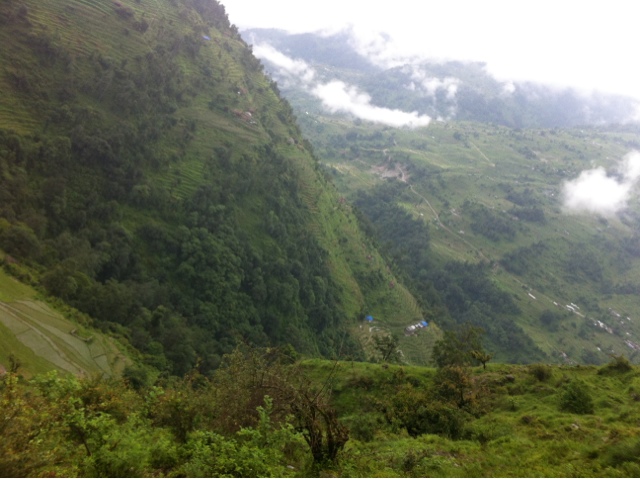
The foothills are something even pictures cannot grasp, and my words certainly hold little power to contain them. Shrouded in mist they play hide and seek, with great, strong bodies that house intricate arteries of rivers and ribboning, dancing falls. They are a deep, untouched green, and they metamorphose into heavenly beasts; covered in eyes they always look at me. As I humbly place each one of my strides on their bones, I find gratitude in the muscle of Earth below me, and below the mountain, and below that. And how they launch me into the Heavens.

There is power here; the river rages and surges with it, the mountain quietly keeps it, the air pulls, passes and pours it. I am so small, and as I cross a wooden bridge or come face to face with a leaping cliff, I am reminded of it with clarity. 

And step-by-step we climb, passing the humble homes of mountain dwellers who hike briskly in flip-flops and rubber boots. Cows and water buffalo moo in the uncomfortable rain, chickens peck pathetically, pausing to shake the water from their feathers and ruffle and re-ruffle themselves. A dog joins us, walking ahead and waiting, watching, perhaps protecting and caring for these bipedal strangers. Four children send warning shrieks from under their umbrellas to ward off the monkeys from their family's maturing corn. Three older, wrinkled, calloused, tanned men and women crush rocks with a small hammer. A bare-breasted woman with suckling child sit on their porch we so invasively pass, and many men and women of all ages carry baskets of greens on their backs, supported by a cloth strap that rests on their crown like a bandanna. To each of these we greet with our hands held together in prayer, Namaste, and they return it. From under their plastic coverings some of the friendlier ones say 'Pani! Pani!' with a smile on their face. Pani means water and they chuckle at our sopping state. I agree with them through tone. Yes, Pani. Tons of it. 

It is monsoon season in Nepal; I have never been so soaked for so long. Some of the best gear is defeated by this onslaught. Wet to the core, we continue to climb to keep warm, and we make good time for it. The real enemy are those slimy suckers that come with the rain. Perched on leaves, trees, rocks leeches attach themselves to passing flesh. When we finally take off our shoes we have endlessly leaking wounds to attend to. A cheesecloth-covered ball of salt is our weapon in removing them as we climb, but some make it through all our defenses. When I finally remove one and kill it, I watch it bleed my own blood. How audacious. 

But we finally make it to Hotel Milan high up in Ghandruk. If the clouds clear we will see the glorious snows of the Annapurna Himalayan Mountain Range. Those are the real beauties. In another season we could climb to the top, but monsoon season makes for snow-storms that are not to be reckoned with too audaciously--we wouldn't want the mountains to make us bleed our own blood, so we tread humbly. For now, we hope just for a peek. 

As we dry and tend to wounds and eat a large lunch the mist and clouds pass and dissipate and we become more and more excited, anticipating what lies behind them. Across the valley a lonely structure manifests and I wonder what it could be, with nothing around it, the closest village half a cliff away, who lives there? What do they eat? How do they even get there? The mysteries of the Himalayas continue on...


And then, in the light of morning, when the clouds haven't yet had time to cover the hills, we finally see behind the veil, and oh!--what a change! Suddenly I'm even smaller. Those mountaintops I was so moved by, whose height I was so impressed with, and breadth in awe of--they become, well, hills. Monstrous, gorgeous, green and white--pure white--peaks have been towering above us all this whole time. So quickly my perspective changes. In just a small space between the creeping clouds I see the rising thrust of Fishtail and my hike, my view, my very self, have all shrunk. In the presence of giants we see ourselves as we ought.

But the sight is short lived. From over the hilltops comes the covering. It hugs the mountainside like a woolen blanket. Like a fleece is sits and contours to the shape of the rolling, jutting earth. Within minutes we can't even see the tops of the hills, our horizon is blurred out, and we are back to a world only meters wide and long. But I'm no bigger; I know now, and I cannot forget what greatness lies all around me: the peaks of the Annapurna.

Tuesday, July 16, 2013

...struggle on

I am still without clothes or toiletries or sandals or that sweet peanut butter I packed because my luggage remains lost in that nexus of traveling. I had to buy some basic things and blushed as my life was on display in the market. Picking out underwear is such an ignoble necessity. Turns out they don't fit so well; the clothes here are made for a smaller sort of person. 

A Tibetan woman who owns a bag shop chuckled as I tried to cram a "Large" hat onto my head. She told me, "they are made for Asian." 

It isn't surprising that there are many Tibetan people living here in Kathmandu and elsewhere in Nepal. They share a border, albeit a trecherous one, and many have fled their homeland because of the Chinese invasion. These whom I interact with are mostly the children and grandchildren of those that made the first flight. 
They are a beautiful people with strong features, wide, high cheekbones and dark eyes. They are kind and hospitable and cook the best food in town. The Tibet Cafe is a favorite of ours, and there we often meet for breakfast or dinner. We eat buffalo chowmein or thukpa (soup and noodles) or eggs and potatoes with cilantro and phale bread. I tried the Tibetan tea once, but couldn't down it. It is a buttery, salty tea and without something like lobster, I just couldn't stomach it. But I had to try it once. 

We frequent the shops around this touristy area to sit and chat and share laughter. We are good friends with several shopowners and families. One sweet family has three children we get to play with and watch grow. The youngest is a girl, and she runs up to my friend Bonnie and gives her a great big hug. She is always smiling or laughing. The middle child is a boy who loves to draw, and has quite the knack for it. He proudly shows us his latest work. And the oldest, also a boy, is bright and kind and aspires to be a doctor some day, perhaps. All three of them walked with us to the illustrious Monkey Temple, or Swayambhu, which included being rained on and climbing 365 steps to the top. 

The temple gets its name from all the monkeys living right around it--those cute, all-too-human creatures with an ominous potential power. I knew if I took out my iPhone to snap a picture, it could become a monkey toy, and it almost did. I escaped with the scratches left over from this monkey who grabbed my arm. Yes, grabbed my arm. A monkey. Grabbed. My arm. 

Swayambhu is a place Buddhists come to worship. This holy site is said to be the resting spot of a giant lotus flower when the Kathmandu valley was drained by a magical sword lifetimes ago. Apparenly this bowl was once a great lake, not a expansive city. And so we climb the stairs, we struggle, one step for each day of the year, to reach the top. This is like their lives, which are lead, day by day, through struggle towards nirvana, or salvation. 

At the top we meet people circling the temple, spinning the prayer wheels as a form of resitation. We also meet hordes of salespersons spinning their stories trying to get our attention to their various wares. I was caught up into a lecture on the creation of these beautiful Tibetan paintings and learned much about the path to real life from their perspective. The young man gave me an impressive presentation about purifying your mind, then speech, then soul towards nirvana through meditation. I asked him where he was on that journey and he chuckled and sat down. 

"That is a good question," he admitted and looked for an answer to a question he never received before. "Somewhere here," he decided as he pointed at the ring around the gates to our mind, which is the beginning. I laughed and said I was probably there as well. But, as nice of a connection as we had, I was politely excused when I offered no interest in purchasing one of his paintings.
View of the Kathmandu valley
So we faced the descent, a year of struggle going up, but just a bit of bouncing to get down. Turns out my legs hurt more leaving salvation than attempting it. And my struggle was waiting for me below as I sweat through my shirt once again, yet had little to change in to. Such is the Nepali life.